What's Hot
    Facebook Twitter Instagram
    Delta Sigma CompanyDelta Sigma Company
    • About
    • Electromagnetics
    • Factory Automation
    • Mixed Reality
    • Learn
      1. Factory Automation
      2. Electromagnetics
      3. Mixed Reality
      4. Course Catalogue
      5. About
      6. View All
      7. View All

      Using Machine Vision To Calibrate Countersink Depth On F-22 Aircraft

      Fuselage Rollover System

      Cargo Ramp Drill

      Automating An Old Drill & Rivet Machine

      Delta Sigma Company at AMTA 2024: Innovating Antenna Measurement Solutions

      A Squat Cylinder-Dihedral Dual Calibration Device for Compact Ranges at UHF

      Canonical Targets in R&D RCS Measurement Range Operations

      Using the Nyquist Sampling Criteria in Antenna and RCS Measurements

      How Gulfstream Paints Aircraft Using Mixed Reality

      Delta Sigma Company Announces Partnership With Zuken USA

      Delta Sigma Company at AMTA 2024: Innovating Antenna Measurement Solutions

      Advanced Robotics Automation Tools

      Advanced Robotics Automation Tools: Revolutionizing Factory Automation Services

      Robotics Automation: Tailored Solutions

      Robotics Automation: Tailored Solutions for Modern Businesses

      Expert Robotics Automation Services

      Expert Robotics Automation Services

      Delta Sigma Company at AMTA 2024: Innovating Antenna Measurement Solutions

      Advanced Robotics Automation Tools

      Advanced Robotics Automation Tools: Revolutionizing Factory Automation Services

      Robotics Automation: Tailored Solutions

      Robotics Automation: Tailored Solutions for Modern Businesses

      Expert Robotics Automation Services

      Expert Robotics Automation Services

      Delta Sigma Company at AMTA 2024: Innovating Antenna Measurement Solutions

      Advanced Robotics Automation Tools

      Advanced Robotics Automation Tools: Revolutionizing Factory Automation Services

      Robotics Automation: Tailored Solutions

      Robotics Automation: Tailored Solutions for Modern Businesses

      Expert Robotics Automation Services

      Expert Robotics Automation Services

      Using Machine Vision To Calibrate Countersink Depth On F-22 Aircraft

      Stacker / Drill Automation

      Using Machine Vision To Assemble The F-22 Fuselage

      Automating RCS Measurements For High-Speed Production Line In-Process Verification

    CONTACT
    Delta Sigma CompanyDelta Sigma Company
    Home»Learn»Industrial Robotics: Transforming Manufacturing Activities
    • Factory Automation

    Industrial Robotics: Transforming Manufacturing Activities

    Facebook
    Twitter
    LinkedIn
    Industrial Robotics: Transforming Manufacturing Activities
    Industrial Robotics: Transforming Manufacturing Activities

    Introduction

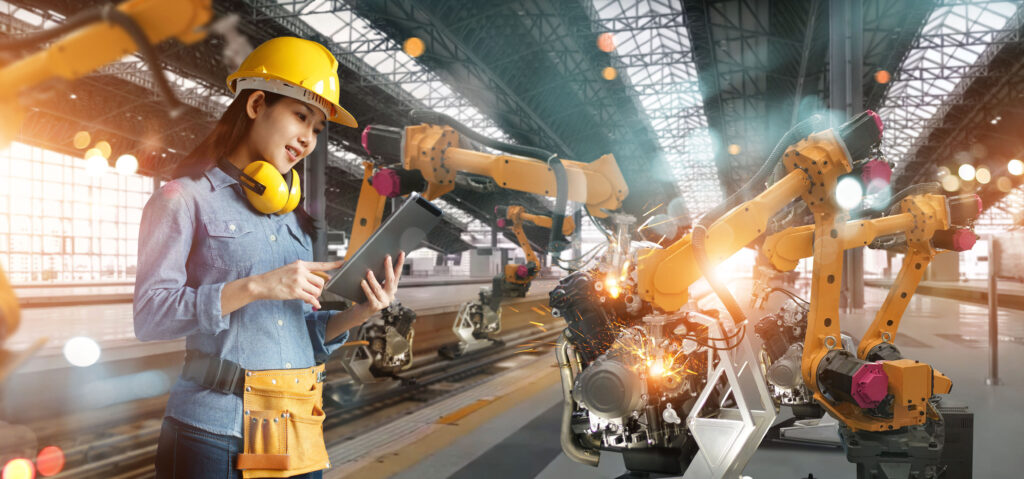
    Industrial robotics technology represents a major advancement in manufacturing, transforming processes, increasing efficiency, and driving innovation. This article explores the transformative impact of advanced industrial robotics on the manufacturing sector, examining its applications, benefits, and future implications.

    Outline

    1. Introduction
    2. Background
    3. Understanding industrial robotics
    4. Applications across manufacturing industries
    5. Advantages of industrial robotics
    6. Challenges and considerations
    7. Future directions and emerging trends
    8. Conclusion
    9. FAQs

    Background

    The incorporation of industrial robotics into assembly processes has a rich history, dating back to the mid-twentieth century. This segment gives an outline of the development of modern industrial robotics, from the acquaintance of programmable machines to the refined automated industrial robotics of today, making way for a more profound investigation of its extraordinary potential.

    Understanding Industrial Robotics

    Modern advanced industrial robotics refers to the use of robots to automate tasks traditionally performed by humans in manufacturing settings. This section examines the components and capabilities of industrial robotics, including sensors, actuators, and controllers, as well as their ability to perform a wide range of tasks with precision, speed, and consistency.

    Applications Across Manufacturing Industries

    Industrial robotics track down applications across assorted assembling businesses, including cars, gadgets, aviation, drugs, and buyer merchandise. This part features certifiable instances of mechanical industrial robotics, from gathering and welding to material handling and quality control, delineating the flexibility and versatility of automated innovation.

    Advantages of Industrial Robotics

    The adoption of modern industrial robotics offers many benefits for manufacturers. These include increased efficiency, improved quality, reduced costs, enhanced safety, and greater flexibility. This section explores how industrial robotics helps companies improve production processes, meet growing demands, and stay competitive in a rapidly evolving market.

    Challenges and Considerations

    While modern advanced industrial robotics holds a huge commitment, its execution additionally presents difficulties and contemplations. This part talks about issues, for example, introductory venture costs, specialized intricacy, labor force removal, network protection gambles, and administrative consistency, featuring the significance of cautious preparation and vital direction.

    Future Directions and Emerging Trends

    Looking ahead, the future of modern industrial robotics is characterized by ongoing innovation and technological advancement. This section explores emerging trends such as collaborative robotics, artificial intelligence (AI) integration, autonomous mobile robots (AMRs), and digital twin technology, all poised to reshape the manufacturing landscape in the coming years.

    Conclusion

    Modern industrial robotics represents a transformative force in manufacturing, enabling companies to achieve new levels of efficiency, flexibility, and competitiveness. By embracing industrial robotics, manufacturers can unlock opportunities for growth, innovation, and sustainable development, propelling the industry into a new era of excellence.

    FAQs

    1. What tasks can industrial robotics perform?

    Industrial robotics can carry out many undertakings, including gathering, welding, painting, bundling, palletizing, and assessment.

    2. How does using industrial robotics benefit you?

    Benefits integrate extended productivity, work on quality, diminished costs, prosperity, more unmistakable flexibility, and the ability to conform to changing business area demands.

    3. What distinguishes collaborative industrial robotics from standard industrial robotics?

    To foster greater ties and easier labor between humans and industrial robotics, helpful industrial robotics, or industrial robotics, are anticipated to operate close to people in shared workspaces.

    4. What are some emerging trends in industrial robotics?

    Emerging trends include the integration of artificial intelligence (AI), the adoption of autonomous mobile robots (AMRs), the use of digital twin technology, and the development of more flexible and collaborative automated robotics.

    5. How can companies overcome the challenges of implementing industrial robotics?

    Companies can overcome difficulties by directing exhaustive achievability studies, putting resources into worker preparation and schooling, teaming up with advanced industrial robotics specialists and providers, and carrying out hearty network safety measures to safeguard delicate information and industrial robotics.

    Share.

    Related Posts

    Delta Sigma Company at AMTA 2024: Innovating Antenna Measurement Solutions

    Services

    A photo of a Compact Antenna Test Range (CATR) facility. The image shows a shielded room with an anechoic chamber, a robotic positioning system, and various measurement equipment, including spectrum analyzers and network analyzers. The control room can be seen through the glass window, where engineers and technicians can monitor the test results. CATR is used for testing and evaluating the performance of small and medium-sized antennas.

    RCS and Antenna Measurement Systems

    "An image of a modern factory utilizing automation services. The photo shows a variety of machines and equipment including robots, conveyor belts, and control systems. In the background, you can see a control room, where operators monitor and control the automation system. The factory floor is clean and well-lit, with workers in safety gear. The automation services aim to improve efficiency, reduce costs, and increase the speed and accuracy of the production process.

    Engineer to Order

    An airplane in the foreground with a projected paint masking pattern overlay, being assisted by ProjectionWorks technology. The technology is used to improve efficiency and accuracy in the paint masking process.

    Digital Thread / Digital Twin

    Editor’s Pick

    Using Machine Vision To Calibrate Countersink Depth On F-22 Aircraft

    Fuselage Rollover System

    Cargo Ramp Drill

    MENU

    • RADAR CROSS SECTION
    • FACTORY AUTOMATION
    • MIXED REALITY

    DISCOVER

    • ABOUT
    • LEARN
    • CAREERS
    • SITEMAP

    CONTACT US

    ADDRESS:
    2125 Barrett Park Dr #110
    Kennesaw, GA 30144

    PHONE:
    (770) 575 – 5100

    EMAIL
    info@deltasigmacompany.com

    FOLLOW US

    • Facebook
    • LinkedIn
    • Twitter
    • YouTube

    PRIVACY

    COPYRIGHT 2024 DELTA SIGMA COMPANY ALL RIGHTS RESERVED.

    Type above and press Enter to search. Press Esc to cancel.